With members on the Palouse, and in the Lewiston-Clarkston Valley and Central Idaho
Current Events Calendar
The following is a list of events
sponsored by White Pine Chapter or in collaboration with other organizations because our members have an interest.
Please check with a contact if you have a specific question or wish to confirm event information.
For a list of events for other INPS chapters, please click on
INPS.
Please mark your calendar with the dates of these meetings, presentations, and field trips. Additional information may also be communicated through chapter email notices, newsletters, and postcards and via public flyers and press releases. We look forward to seeing you on these educational excursions.
PDF format documents listed below require Acrobat Reader 
2026 Schedule
Upcoming Events
**************************************************************************************
More information on upcoming events will be posted when information becomes available.
It will also be sent to members via email. Virtual programs are generally recorded and posted on our You Tube channel.
Please see the left navigation bar for a link.
**************************************************************************************
Weekend, July 10-12, 2026. INPS 2026 Annual Meeting hosted by Loasa Chapter
Thompson Flats Campground • Mt. Harrison, Idaho
Registration is open
For full information watch for postings on the INPS website
INPS 2026 Annual Meeting and writeups in Sage Notes.
**************************************************************************************
Saturday-Sunday, July 11-12, 2026. White Pine Chapter and Palouse Prairie Foundation Grass Identification Workshop
Leaders: Eva Strand, Steve Bunting, Karen Launchbaugh
Classroom session Saturday, July 11; Field Trip Sunday, July 12
The workshop is limited to 20 participants with priority given to INPS and PPF current members.
An email will be sent out to members soon detailing how to register.
If you are not a current INPS member you can join or renew here: INPS Membership.
Poster: Grass Workshop Poster
Workshop: In a classroom session July 11, you will learn grass taxonomy and morphology, how to
use a dichotomous key, and how to identify grasses common on the Palouse. The following day (July 12),
we will go on a field trip to Tom Besser and Kathy Potter’s place and to the Phillips Farm (both
within 5 miles of Moscow) to see and identify grasses in their natural environment. Bring a hand
lens and grasses you would like help identifying. We will use the Field Guide to Grasses and
Grasslike Plants of Idaho and the associated phone app (available for iPhone and Android).
Presenters: Eva Strand, Steve Bunting, and Karen Launchbaugh are retired and current
Professors of Rangeland Ecology at the University of Idaho. Together, they have a century of
experience in rangeland ecology, habitat assessments, and plant identification. information to follow.
If you have questions, please contact Judy Ferguson send email.
**************************************************************************************
Sunday, July 12, 2026. 9:00am-Noon(ish), White Pine Chapter Plant Walk
Warnick Road parking Area, Moscow Mountain
Orchids and Wintergreens, Oh My!
Leaders: Lisa Morris and Penny Morgan
Did you know that there are eight different wintergreens and about a dozen orchids that grow on Moscow Mountain? Many of these (though not all) bloom mid-summer and we'll go in search of them. We will see many other mountain plants along the way with some still in bloom.
We can gather at Mountain View Park in Moscow at 8:45 to carpool.
The field trip will start and end at the Warnick Road Parking Area on Warnick Road on Moscow Mountain. ( Parking area map ). This location is roughly 7.5 miles from Mountain View Park and about half of the distance is gravelly, windy roads. We'll need drivers with this type of driving experience. In the summer, most any car can make the trip.
We'll hike up the lower portion of LaFortune's Flight trail and come down past the site of the old Warnick Cabin on an unused road. The total distance hiking is roughly 2.5 miles.
The trails are steep in places, so we recommend good shoes and hiking poles if you use them. Please bring water, snacks, hats, and sunscreen.
Previous 2025-2026 Events
**************************************************************************************
Wednesday, January 15, 2025. 7:00 pm PST. White Pine Chapter Regular Meeting
Presentation: Flowering Plants along Moscow Mountain Trails: Treasures in our Backyard
Speaker: Lisa Morris
Location: Lecompte Auditorium, 2nd Floor, 1912 Center, 412 E. 3rd St., Moscow, Idaho
Enjoy the multitude of native plants Lisa Morris finds along the trails she hikes on Moscow Mountain. Lisa hopes her photos of both common and not-so-common native plants will inspire you to walk the trails as well and marvel at the biodiversity on Moscow Mountain. Learn about the trails, hear her stories, and delight in spring, summer, and fall native plants growing on Moscow Mountain.
Lisa Morris is a self-taught plant enthusiast. Her endless curiosity and energy lead her to explore nearby trails almost every day, no matter the season. Using iNaturalist and her phone, she's identified about 400 and counting species on Moscow Mountain. She delights in the plants, fungi, mosses, convergent lady bugs, ice crystals, people, and all she finds along her way.
Flyer: Morris poster
Recording is available: The recorded presentation can be found on the chapter YouTube channel Moscow Mountain Wildflower Trails by Lisa Morris.
**************************************************************************************
Wednesday, February 19, 2025. 7:00 pm PST. White Pine Chapter Regular Meeting
Presentation: Fascinating and Essential: Grasses and Grasslands
Speakers: Eva Strand and Steve Bunting
Location: Lecompte Auditorium, 2nd Floor, 1912 Center, 412 E. 3rd St., Moscow, Idaho
Presentation: The grass family (Poaceae) is a large and nearly ubiquitous family of over 11,500 species with grasslands covering approximately 40% of the Earth’s land surface. Grasses are a primary food source for humans and animals (wild and domestic). Grasses prevent erosion and provide a variety of ecosystem services including vital habitat for animals. In spite of their importance to humans, grasslands are vulnerable to development and land conversion, and they are rarely protected by federal or local policies. Join us to learn more about this fascinating and essential family of plants and their habitats!
Steve Bunting and Eva Strand, Professors of Rangeland Ecology at the University of Idaho, have conducted field research in grasslands, shrublands, and woodlands for three decades. In this presentation they share their knowledge and thoughts about one of the most important plant families on Earth – the grass family.
Flyer for this event Grasses and Grasslands poster
Recording is available: The recorded presentation can be found on the chapter YouTube channel Fascinating Grasses by Bunting and Strand.
Program is free and open to all.
**************************************************************************************
Saturday, March 22, 2025. 12:00-3:00 pm PDT. Conservation Project, with UI Conservation Biology Club
Volunteers can find more information about the location and the planned activities on the following document which will be updated as needed.
Conservation Projects Information
**************************************************************************************
Wednesday, March 26, 2025. 7:00 pm PDT. White Pine Chapter Zoom Meeting
Speaker: Dr. Leda Kobziar, Professor of Wildland Fire Science, University of Idaho,
Presentation: Microbial Content of Wildfire Smoke
Program will be presented online (and recorded) via Zoom (Zoom id will be sent via email to members or can be found on the flyer)
In the last few years, our research has revealed that multiple trillions of living microbes are transported from soils and plants into smoke during wildfires and prescribed burns. What types of microbes, how many, and how far they are transported depend on the ecosystem burning as well as the characteristics of fire behavior. This presentation will highlight what we know about the repercussions of this microbial transport mechanism for the health of plants, animals, and people downwind.
Dr. Leda Kobziar is the Professor of Wildland Fire Science in the Department of Forest, Rangeland, and Fire Sciences at the University of Idaho and director of the Master of Natural Resources program. Her research focuses on the emission and transport of living microorganisms via wildland fire, referred to as “pyroaerobiology” (PAB).
Poster Kobziar poster
Recording is available: The recorded presentation can be found on the chapter YouTube channel Wildfire smoke by Leda Kobziar.
Program is free and open to all.
**************************************************************************************
Saturday, March 29, 2025. 10:00 am-12:00 pm PDT. Conservation Project, with Moscow High School, Harvest Park (Dogleg)
Volunteers can find more information about the location and the planned activities on the following document which will be updated as needed.
Conservation Projects Information
**************************************************************************************
Saturday, April 12, 2025. 12:00-3:00 pm PDT. Conservation Project, with UI Conservation Biology Club
Volunteers can find more information about the location and the planned activities on the following document which will be updated as needed.
Conservation Projects Information
**************************************************************************************
Thursday, April 24, 2025. 7:00 pm PDT. White Pine Chapter Regular Meeting **date and room revision
Speaker: Kali Armitage and Steve Bunting
Presentation: Bringing Back the Palouse Prairie: Exploring Moscow's Urban Native Plant Communities
Location: Arts Room, 1912 Center, 412 E. 3rd St., Moscow, Idaho
Join us for a presentation exploring the beauty and benefits of Moscow's native plant communities! Discover inspiring examples of local yards where passionate land stewards are creating pollinator habitats, conserving water, and designing low-maintenance, sustainable landscapes. Whether you're looking to enhance your yard with natural beauty or make eco-friendly choices, you'll leave with valuable tips on plant selection and implementation. Plus, learn about upcoming yard tours and get inspired by what's possible right here in our community.
Kali Armitage is an amateur native plant enthusiast and habitat creator. Steve Bunting is a retired professor of rangeland and landscape ecology from the University of Idaho.
There will be no YouTube recording of this in person presentation.
Program is free and open to all.
**************************************************************************************
Saturday, April 26, 2025. 12:00-3:00 pm PDT. Conservation Project, with UI Conservation Biology Club
Volunteers can find more information about the location and the planned activities on the following document which will be updated as needed.
Conservation Projects Information
**************************************************************************************
Sunday, May 4, 2025, 2:00 pm. Chapter Plant Walk led by Pam Brunsfeld.
Afternoon informal walk to see early spring flora on Balsam Route on Moscow Mountain.
Meet at the north end of Mountain View Park parking lot to arrange carpooling as parking is limited near the Route trailhead.
Bring water, walking sticks, hat, shoes for trail walking.
If it rains the walk is cancelled!
**************************************************************************************
Tuesday, May 13, 2025. Chapter Plant Walk. Evening walk at Robinson County Park led by Pam Brunsfeld.
Meet at the Latah County Fairgrounds Animal Barns at 4:30 for carpooling. It is a short ten minute drive to the park.
Bring whatever makes you comfortable for a short, slow hike - hat, comfortable walking shoes, water, walking sticks, etc. A species list will be provided.
Rain Cancels.
**************************************************************************************
Long weekend, May 14-17, 2025 Annual White Pine Chapter Native Plant Sale
As with last year's sale it will include an online sale (May 14-16) with in-person pickup, followed by an in-person sale (May 17)
Location: Latah County Fairgrounds Depot Building, 1021 Harold Ave, Moscow, Idaho
Full details including the Availability list, the PREVIEW URL, and additional instructions will be available on the chapter website about May 1
INPS White Pine Chapter website home page
Please print and post a flyer to help publicize this event. 2025 Plant Sale poster
You may need to click on 'page fit' at top if it is too large.
Over 4000 plants and over 100 native species will be available. Check out the Availability list now! and start making your plans.
**************************************************************************************
Tuesday, May 20, 2025. 9:00 am to noon PDT. Conservation Project Idler's Rest, Stage Memorial Plantings Weeding led by Penny Morgan
Volunteers can find more information about the location and the planned activities on the following document which will be updated as needed.
Conservation Projects Information
**************************************************************************************
Revised date
Friday, May 30, 2025. 3:00 pm. Chapter Plant Walk. Afternoon walk in to view Vassar and Bronson Meadows camas fields.
Leader: Pam Brunsfeld
This walk is being rescheduled due to the delayed flowering of Camassia quamash. It is an excellent year for camas and a site to behold. In fact, Meriweather Lewis in June of 1806 when first entering Idaho on the Camas Prairie wrote "from the colour of its bloom at a short distance it resembles lakes of fine clear water, so complete is this deseption that on first site I could have swoarn it was water. (sic)"
The walk into the meadow is about one mile on a gated road but the walk will be extremely slow as we view the flora in the area (referred to as the "botanist crawl"). Pam will provide a species list and recommends bringing a snack. Cookies will be provided.
Carpooling: Meet at 3:00 at the Eastside Mall near the end of the Dollar Tree.
If you have any questions please send an email to Pam.
Heavy rain cancels.
**************************************************************************************
Weekend, May 30 - June 2, 2025. INPS Annual Meeting. Based out of Three Island Crossing. Hosted by Pahove Chapter.
INPS Annual Meeting Announcement
**************************************************************************************
Saturday, May 31, 2025. 9:00 am to 11:00 am PDT. Conservation Project, Idler's Rest, Stage Memorial Plantings Weeding led by Penny Morgan
Volunteers can find more information about the location and the planned activities on the following document which will be updated as needed.
Conservation Projects Information
Later the same day at 11:00 am PDT. A Dedication Ceremony and Celebration to be led by the Palouse Land Trust.
For more information see the email sent to members and friends or see the Palouse Land Trust webpage Marjory Stage Memorial Bench Dedication
**************************************************************************************
Long weekend, June 5 - June 9, 2025. Intermountain Botanical Foray. Based out of Stillwater Campground (Utah) on Bear River (40.8690476,-110.834664), Uinta Wasatch-Cache National Forest.
More information to follow in emails.
**************************************************************************************
Thursday, June 5, 2025. 4:00-7:00 pm. YARD TOURS in Moscow. Watch your email for further information.
Please join us on June 5 from 4-7 pm to tour native plants in yards and gardens in Moscow. Come enjoy the beauty of native plant gardening. If you did not receive an email from the chapter, send an email to whitepine.chapter@gmail.com for more information. 6 yards will be on the tour. 831 So Hayes Street in Moscow is one of the homes so feel free to start there and get a flyer for the other addresses.
Please respect owners' privacy and only visit yard areas open to viewing and ONLY visit from 4-7:00 pm on June 5, 2025.
**************************************************************************************
This walk has been cancelled by the leader. Please let others know.
Saturday, June 7, 2025. Chapter Plant Walk. Afternoon walk in White Pine Campground area. We hope to see the rare plant, clustered lady's slipper, Cypripedium fasciculatum. Plant walk led by Pam Brunsfeld. Where and when to meet for carpool To Be Announced.
**************************************************************************************
Monday-Tuesday, June 9-10, 2025. Field Trip to Heyburn State Park, optional campout
Develop plant species list for Heyburn State Park with
Leaders: Derek Antonelli, Pam Brunsfeld, Judy Ferguson
White Pine Chapter and Calypso Chapter of the Idaho Native Plant Society are joining forces to do an inventory of plants found at Heyburn State Park. We are asking for your help. Heyburn State Park is close enough to drive up from Moscow and Potlatch each day, but if you want to camp overnight, please reserve a campground spot. If you already have an Idaho State Park Pass on your car, you can get into the park for free. If you do not have one, please get in touch with Judy Ferguson, Conservation Chair on the White Pine Website or send Judy an email and say you are going. The Park will provide a pass for your volunteer effort. If you wish to camp on June 9, you are responsible for reserving and paying for your own campsite. Some of us are making reservations at Hawley’s Landing, but it is filling up, so if you want to camp, please reserve something as soon as possible. We will meet at Hawley’s Landing Campground at 8:30 a.m. June 9 to begin the day’s inventory. You do not need to be an expert at identifying plants. You can be a finder of new species, a photographer, an iNaturalist contributor, and so on. Remember if you need a State Park Pass for this outing, please contact Judy. Hope to see you there!
Attendees will help develop a plant species list for Heyburn State Park.
Watch your email for further information.
**************************************************************************************
Saturday, June 14, 2025. 9:00 am to 4:00 pm. All day Chapter Field Trip to Elk Creek Falls.
Leader: Juanita Lichthardt
Meet at the south side of the Eastside Marketplace parking lot in front of the Dollar Store (near Highway 8) to organize carpooling.
A one-hour drive on paved roads will take us to the Elk Creek Falls Recreaion Area. We will be hiking and botanizing on the 2 1/4 mile loop trail that, with some backtracking, will afford views of all three falls. The mostly shaded trails are wide and gently sloped, but bring hiking poles if you usually use them. We do not plan on doing the steep switchbacks to the plunge pool of the middle falls. We will see a diversity of forest understory plants as well as those of a small grassy bald.
Bring a lunch, water, hat, sturdy walking shoes, and dress for possible inclement weather.
We welcome kids. If you bring a dog, please have them on a leash.
**************************************************************************************
Sunday, June 15, 2025. 9:00 am to 11:00 am PDT. Conservation Project, with UI Conservation Biology Club members
Volunteers can find more information about the location and the planned activities on the following document which will be updated as needed.
Conservation Projects Information
**************************************************************************************
This field trip has been cancelled due to forecast of high winds in the area. Please let others know. It will be rescheduled.
Saturday, June 21, 2025. Chapter Field Trip to Restoration Zero project near Deary (Pam and Brian Robertson)
Please watch a background video on their YouTube channel
Little Bear Creek
and check a website about the project from Land Trust Alliance
"https://landtrustalliance.org/blog/landowner-driven-restoration-in-idaho" >Landowner Driven Restoration Project
Where and When to meet to be announced.
**************************************************************************************
Unfortunately this field trip has had to be cancelled due to staffing issues. Please let others know. Weeding and visit to Sublime Point will be rescheduled .
Saturday, June 28, 2025. 9:00 am-6:00 pm PDT. Conservation Project, Sublime Point, McCroskey State Park
Volunteers can find more information about the location and the planned activities on the following document which will be updated as needed.
Conservation Projects Information
**************************************************************************************
Saturday, July 20, 2025. 8:00 am-10:00 am PDT. Conservation Project, with UI Conservation Biology Club members
Volunteers can find more information about the location and the planned activities on the following document which will be updated as needed.
Conservation Projects Information
**************************************************************************************
Tuesday, September 16, 2025. 7:00 pm PDT. White Pine Chapter meeting
Topic: UI Students Create Large Pollinator Garden
Presenters: UI Students Zoe Doerr, Stephen Lemeshko and JW Fay
Location: Lecompte Auditorium, 2nd Floor, 1912 Center, 412 E. 3rd St., Moscow, Idaho
Zoe Doerr and Stephen Lemeshko are the current and former Presidents of the University of Idaho Student Chapter of the Society for Conservation Biology. JW Fay is the current President of the Student Chapter of the American Society of Landscape Architecture.
Students led the design, development, and ongoing management of this native plant garden. Two student clubs engaged students and staff from across campus. With a rock garden, a small prairie, and educational signs, this garden is designed for bees, butterflies, and student learning. Public art displays were added this summer.
Flyer: UI Student Park poster
Recording is available: The recorded presentation can be found on the chapter YouTube channel UI Student Garden .
**************************************************************************************
Saturday, October 18, 2025. 4:00 pm - 6:45 pm PDT. Two events (come for one or both)
Location: Lloyd Park 2370 North Polk Ext, Moscow, Idaho.
5:00-6:45 pm Annual Meeting of White Pine Chapter members. Includes dinner at 5:00 (please bring a side dish to share and your own nonalcoholic drinks; pizza and salad will be provided by the chapter). Annual meeting will include a brief survey summary and outlook for our chapter followed by election of board members.
4:00-5:00 pm Please join UI students and faculty in identifying and labeling the many different native and non-native trees planted in Lloyd Park by the Lloyd family
Robert Edwin Lloyd Park - This new Latah County Park has newly constructed parking area, picnic shelter with tables and restroom. No alcohol or dogs allowed by park rules. North Polk Ext parallels Hwy 95 going north out of Moscow. The park is approximately 1 mile past the turnoff to PCEI on Polk.
**************************************************************************************
Tuesday, October 21, 2025. 7:00 pm PDT. White Pine Chapter meeting
Topic: Native Plant Seeding & Transplanting in the Fall
Presenters: David Herbold, local landscaper; Penny Morgan, President of White Pine Chapter, INPS
Location: Lecompte Auditorium, 2nd Floor, 1912 Center, 412 E. 3rd St., Moscow, Idaho
Zoom option: Zoom link
Come learn from those who have had great success establishing native plants in the fall. They transplant to expand natives in their yard. They collect seed and then sow the seeds late in the fall just before snow falls.
David Herbold has guided the landscaping at Palouse Prairie Charter School with students, parents, and teachers to create learning moments and places. He aids local landowners with native plant projects as part of his local business, Woodstack LLC. Penny Morgan loves the beauty and wonder of native plants. She became President of the White Pine Chapter of Idaho Native Plant Society after retiring as a professor of fire ecology and management at the University of Idaho in 2019. Our local panelists include Helen Stroebel, Tom Besser, Sarah Metcalf, and more.
Flyer: Native Plant Seeding in Fall
Recording is available: The recorded presentation can be found on the chapter YouTube channel Native Plant Seeding & Transplanting in the Fall.
**************************************************************************************
Tuesday, November 18, 2025. 7:00 pm PDT. White Pine Chapter meeting
Topic: Bodacious Botanicals
Presenters: Jolie Kaytes, Professor of Landscape Architecture, Washington
State University.
Location: Lecompte Auditorium, 2nd Floor, 1912 Center, 412 E. 3rd St., Moscow, Idaho
Jolie Kaytes is a professor of landscape architecture at Washington
State University. Her work explores how landscapes are represented and
contemplates the importance of place. She has written about the parallels
between drawing and science; composed poetry about geology; curated
exhibits that invite citizens to imagine potential futures for their landscapes; and
produced essays that consider the tangible and invisible marks people make in
places. She is a National Endowment for the Humanities grant recipient and her
writing and images have appeared in numerous publications.
Bodacious Botanicals explores how embracing so-called
"invasive" vegetation fosters novel ways of being in, being with, and
befriending the world. With hopeful curiosity and playful introspection, the
presentation will invite the audience to ponder the insidious way words can
divide us from other lifeforms and consider how seeing invasive plants as kin
complicates and invigorates our understandings of belonging and home.
Please print and post this flyer to help us publicize the event: Jolie Kaytes poster
This presentation was not recorded (presenter's request)
**************************************************************************************
Tuesday, January 20, 2026. 7:00 pm PST. White Pine Chapter meeting
Topic: The Amazing Netleaf Hackberry
Presenter: Richie Thaxton, PhD student, Idaho Tree Ring Lab, University of Idaho
Location: Lecompte Auditorium, 2nd Floor, 1912 Center, 412 E. 3rd St., Moscow, Idaho
A Mixed-Method Approach to Understanding Changes in Celtis reticulata Populations on the Lower Salmon River.
Recent observations indicate netleaf hackberry (Celtis reticulata) in Idaho is expanding into riparian areas at the same time abundance decreases in the uplands. To better understand the extent and magnitude of these changes on the lower Salmon River, we revisit netleaf hackberry sites first studied 30 years ago. We employ a mixed method approach - vegetation transects, repeat photography, and dendrochronology - to identify how hackberry populations on the Lower Salmon have changed over the last 30 years and identify if changes are driven by changes in moisture availability.
Richie Thaxton is a fourth-year PhD student at the University of Idaho Tree Ring Lab. His previous work has used dendrochronology to understand changes to riparian cottonwood forests in the Western US affected by human-caused changes in streamflow. For his PhD he is working with Grant Harley to better understand drivers and changes in southeast US streamflow using tree rings.
Poster Richie Thaxton presentation poster
Recording is available: The recorded presentation can be found on the chapter YouTube channel Celtis reticulata .
**************************************************************************************
Wednesday, February 11, 2026. 7:00 pm PST. White Pine Chapter meeting
Topic: The Wonderful World of Penstemons
Presenter: Pam Brunsfeld, Botanist and Retired Director of the University of Idaho Stillinger Herbarium
Location: Lecompte Auditorium, 2nd Floor, 1912 Center, 412 E. 3rd St., Moscow, Idaho
Zoom id will be sent out to members and friends before the meeting. It can also be found on the poster.
Pam Brunsfeld will speak about Penstemon, the largest genus of flowering plants endemic to North America. You will learn how to identify different Penstemon species and how to grow them successfully. In her front yard, Pam cultivates a collection of Penstemon that evokes a sense of wonder and enchantment.
Pam Brunsfeld has been a professional botanist for over 50 years. She is the retired Director of the University of Idaho Stillinger Herbarium, Systematic Botany instructor, Forest Service botanist, and currently owner of Brunsfeld Botanical consulting firm. Pam is also a beekeeper and will have Penstemon honey available for purchase this year. Stay tuned!
Recording is available: The recorded presentation can be found on the chapter YouTube channel The Wonderful World of Penstemons by Pam Brunsfeld .
**************************************************************************************
Tuesday, March 17, 2026. 7:00 pm PDT. White Pine Chapter meeting
Topic: Iceland: A Late Spring Tour with Birds, Flora, Scenery and Friends
Presenter: Nancy and Reid Miller
Location: Lecompte Auditorium, 2nd Floor, 1912 Center, 412 E. 3rd St., Moscow, Idaho
Presentation: At the end of May 2025 Reid, Nancy and their son Craig traveled for about two weeks in Iceland. Craig did most of the research using eBird’s data to determine many of our birding destinations. Although Iceland offers many forms of recreation and many areas of interest, the three of us concentrated on enjoying the scenery and on identifying birds and flora in the southwest and the north of this beautiful island. We luckily were able to be there at a time when migratory birds were nesting, and some native flowers were in bloom. Many birds we saw were familiar to us but were behaving differently and in different habitats. Many plants we saw were totally new to us, but others were the same or similar to Idaho’s natives.
Reid & Nancy Miller are longtime members of INPS and this chapter. At their home on the north side of Moscow Mountain, they watch many birds of the woodland and prairie and enjoy the progression of blooms of the native forbs and shrubs. They have been fortunate to be able to travel to a number of countries for work and for pleasure and on nearly every trip have spent considerable time learning the birds of the country and often the plants as well. Nancy especially likes to garden and photograph birds and flora. Reid enjoys learning about the geology of areas and has a special interest in identifying hawks and shorebirds.
Poster: Iceland birds and flora
Recording is available: The recorded presentation can be found on the chapter YouTube channel Miller - Iceland birds and flora .
**************************************************************************************
Saturday, April 18, 2026. White Pine Chapter Native Plant Society Walk.
Location: Kamiak Butte
Leaders: Juanita Lichthardt, Lisa Morris
Moscow meeting place: 9 am at the east end of the Rosauers parking lot to arrange carpooling (411 N Main Street, Moscow, Idaho)
Pullman meeting place: Kamiak Butte County Park between 9:45 and 10:00 am
All are welcome
Join us in welcoming spring with a walk up Kamiak Butte. Juanita Lichthardt and Lisa Morris will guide. We will walk the 2.5-mi loop trail in clockwise fashion beginning with the short (1/2 mi) but somewhat steep, well-switch backed, ascent to the ridge through forest. As plant enthusiasm dictates, we will move slowly with many stops.The ridge affords views of the Palouse and early wildflowers of open grassland. (This could be a turn-around point for those who do not wish to continue to walk the trail ). The trail then follows the ridge west for another mile with a moderate, but steady climb. It also becomes rocky and uneven. Before heading back down through the forest to the parking lot (1 more mile) we will pause for lunch and those who wish can take the short (0.1 mi round trip), very steep climb to the summit of Kamiak Butte. Walking sticks will be handy on our descent.
Some participants may be documenting flora and wildlife with iNaturalist. If you would like to learn how iNaturalist works, please download the app to your mobile phone prior to the trip. (iNaturalist.org correction) You may create a free login or use Seek with no account. Lisa will be available to assist.
Moscow folks: meet at 9:00 at the east end of Rosauers parking lot to organize a carpool. The drive to Kamiak Butte County Park is 35 minutes.
Pullman folks: meet us at Kamiak Butte County Park between 9:45 and 10:00.
If we begin our descent from the ridge at about 1PM we should be back by 3.
Bring sunscreen, water and lunch. Walking sticks will be helpful. Ticks will undoubtedly be present.
Weather plan: be at the meeting point at 9, we'll consult the forecast and the heavens and make a group decision. Contact: Juanita Lichthardt (208-301-4954)
**************************************************************************************
Tuesday, April 21, 2026. 7:00 pm PDT. White Pine Chapter meeting jointly sponsored by Palouse Prairie Foundation
Topic: Conservation and Development at McCroskey State Park
Presenters: Nathan Blackburn for Idaho Department of Parks and Recreation
University of Idaho faculty members Chris Zajchowski and Mary Engels
Location: Lecompte Auditorium, 2nd Floor, 1912 Center, 412 E. 3rd St., Moscow, Idaho
The presenters will discuss how ongoing management challenges are being addressed, including the Palouse Prairie remnants near Sublime Point along Skyline Drive and trails. They will also talk about leveraging University of Idaho undergraduate coursework to enhance student learning, while advancing planning and management efforts for Mary Minerva McCroskey State Park. Attendees will be invited to consider next steps for developing collaboration and stewardship capacity at McCroskey State Park in a time of uncertainty and decreasing State appropriations.
Nathan Blackburn is a Park Manager with the Idaho Department of Parks and Recreation. Dr. Chris Zajchowski and Dr. Mary Engels are faculty members at the University of Idaho in the Department of Natural Resources and Society. They have all been engaged in questions related to the conservation of the remnant Palouse Prairie at Mary Minerva McCroskey State Park. Many undergraduate and graduate students at the University of Idaho have been working on various aspects of conservation as part of courses or in graduate studies.
Please print and Post a poster: McCroskey Conservation
**************************************************************************************
Monday, April 27, 2026. City Nature Challenge Observations with Lisa Morris
Location: Latah County
Leader: Lisa Morris
The City Nature Challenge 2026 runs from April 24 to April 27.
Anyone is invited to participate by adding observations to iNaturalist.org in this date range. The Palouse Conservation District is sponsoring a local project for the CNC, City Nature Challenge 2026 Palouse Region. One can join the project through iNaturalist and participate in a friendly competition between Latah and Whitman counties. For more information and tutorials, visit CNC.
To promote the Latah county efforts, Lisa Morris will be out collecting data on Moscow Mountain on Monday afternoon April 27. This is not a field trip but simply an opportunity to collaborate on the CNC. There are many trails and roads with plenty of accessible specimens. One can choose one's own distance. Observations (animals, flora, insects, etc) for this project are to be made in the wild, not cultivated or domesticated.
In iNaturalist, to join this project click on Community tab, Project tab, search on 'City Nature Challenge 2026: Palouse Region'
Check out Palouse CD. for more information.
If you would like to collaborate with her or need more information, please contact Lisa at
send email.
**************************************************************************************
May 13-16, 2026. White Pine Chapter Native Plant Society. Save these dates.
Location: Latah County Fairgrounds, Depot Building
Plant Sale Chair: Penny Morgan
Full information will be on the chapter website
about May 2.
**************************************************************************************
Sunday, May 17, 2026. White Pine Chapter Field Trip.
Location: Wildflower Tour on Craig Mountain
Leader: Sally Konen and Pam Brunsfeld
Moscow meeting place 8:20 am south end of the East Side Mall
Lewiston and eastern counties meeting place at parking lot at the turnout on Stagecoach Rd. about 0.5 miles past Waha Lake by 9:30 am
The day after the plant sale ends, White Pine is heading out to see wildflowers!! It will be great timing to see wildflowers on Craig Mountain, a great place to understand why we are so excited to share the beauty of native plants at our annual native plant sale! Sally and Bruce Konen own land on Craig Mountain, and they have generously invited the White Pine Chapter to come enjoy the spring wildflower blooms!
People from the Moscow area should gather at the south side of the East Side Mall by 8:20 am to carpool. We are hoping to get down to fewer vehicles.
People from the Lewiston area and our eastern counties please gather in the parking lot of the turnout on Stagecoach Road about 0.5 mile past Waha Lake by 9:30.
There are restrooms at the parking lot. (If you need more detailed directions or have questions, contact Judy send email).
Please bring a sack lunch, water, hat, and hiking boots. Other good things are a hand lens, notebook, a camera or phone camera, and hiking pole. We will be out until mid-late afternoon.
**************************************************************************************
Saturday, May 30, 2026. 11:00am - 3:00pm White Pine Chapter Field Trip.
Location: Moscow Mountain Field Trip
Leader: Tom Besser and Lisa Morris
Approximate times (see PDF below for full details)
11:00am Tom Besser's Reconstruction project
1:00pm Lisa Morris walk along the creek Headwaters Trail
Check out this pdf
Moscow Mountain Field Trip
Please bring a sack lunch, water, hat, and hiking boots. Other good things are a hand lens, notebook, a camera or phone camera, and hiking pole. We will be out until mid-late afternoon.
Carpoolers can meet at the north end of the Moscow Rosauers parking lot at 10:45. Or, drive directly to and park at the south end of the MAMBA Headwaters trailhead on Foothill Rd.
**************************************************************************************
Saturday, June 6, 2026. White Pine Chapter Field Trip.
McCroskey Penstemon attenuatus color variants with Pam Brunsfeld!
Location: Mary McCroskey State Park
Leaders: Pam Brunsfeld and Judy Ferguson
Check out this poster
McCroskey Field Trip Poster
McCroskey State Park Species List 062626
Join us for a day trip to Mary McCroskey State Park to view an abundance of wildflowers and witness two special things. First, taper-leaf Penstemon, Penstemon attenuatus, is normally blue to violet purple. At the park you will see a population extending miles, that ranges from white to pale pink to rose, to light blue or lavender, to deep purple and blue. This is only reported, in the latest edition of the Flora of the Pacific Northwest, to occur in one other locality in eastern Oregon.
Second, the chapter, under the direction of Judy Ferguson, Penny Morgan and Tom Besser, have been working with park officials developing a voucher garden in a disturbed area near a campground that can be used to provide native seeds for restoring disturbed areas of the Park, including areas around and near Sublime Point, a magnificent part of the park that overlooks the Palouse.
Meet at 9:30 at the Moscow Rosauer’s parking lot to arrange carpooling (look for a green Subaru Forester with kayak racks). In the park we will travel on a 17-mile gravel road (fine for passenger cars) and return via US 95 south of Tensed. Bring lunch, water, hat, etc. This will mainly be roadside botanizing, but if walking sticks make you more comfortable for short distances, bring them. We will return mid-late afternoon.
A species list will be provided. Heavy rain cancels.
**************************************************************************************
Thursday, June 11, 2026. 4-7pm White Pine Chapter sponsored Yard Tours
Tour magnificent yards with native plants
Please join us on Thursday, June 11, from 4-7pm to tour native plants in yards and gardens in Moscow. Come enoy the beauty of native plant gardening. The home owner will be available to answer questions at each location. It is springtime on the Palouse so come prepared for mosquitoes and spring weather.
Addresses:
1810 Lorien Lane
1742 Lorien Lane
2809 Hampton Court
Visit the sites in any order you choose.
Please respect the owners' privacy and only visit yard areas open to viewing, and ONLY from 4-7pm on Thursday, June 11, 2026. Thank you!
Handouts will be available.
**************************************************************************************
Saturday, June 20, 2026. 9am meet to carpool. White Pine Chapter Field Trip.
Restoration Zero: Recovery of a functional floodplain
Hosts: Brian and Pam Robertson
Chapter Leader: Tom Besser
Meet at the East Side Marketplace sign in Moscow at 9 am on Saturday, June 20 to arrange carpooling.
We will arrive at the site (1060 Old Avon Rd, Deary ID) to start the tour at approximately 10 am.
This field trip will explore a unique riparian restoration project along Little Bear Creek outside Deary Idaho. The Robertson's objectives were to restore the wetlands to their historic condition, hold water in the upper watershed, recharge the aquifer and improve habitat for aquatic and terrestrial wildlife both locally and downstream. After reviewing several restoration options, the Robertsons elected to return the land to "Stage 0": the historical pre-disturbance wetland conditions, since the subsequent damage to the valley had been so severe.
This project included seeding more than 10 grass species and more than 30 forb species suitable for riparian areas, which we can look for while exploring the project area. There is a level gravel trail on the east side of the project that is suitable for any footwear. If you want to venture deeper into the project, wear waterproof boots and bring along a walking stick! Don't forget binoculars if you want to see birds.
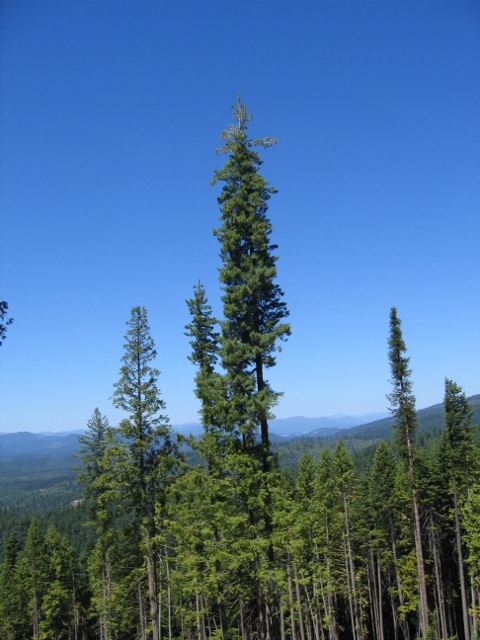
PREF Creek May 0501012: Western white pine at
Priest River Experimental Forest taken by Russell Graham.